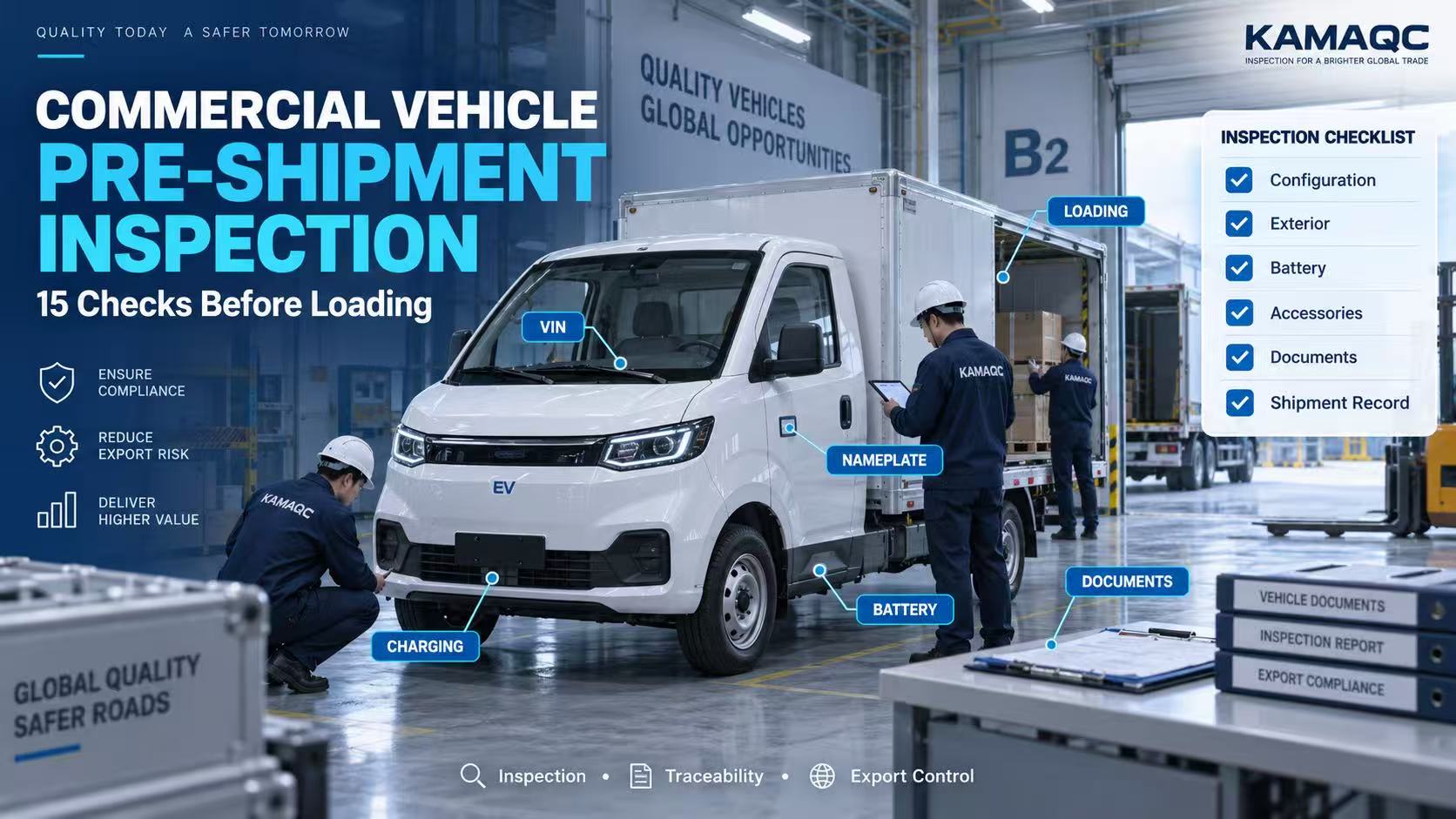
Commercial Vehicle VIN and Nameplate Verification Before Shipment: Importer Checklist
Commercial Vehicle VIN and Nameplate Verification Before Shipment: Importer Checklist
A commercial vehicle may appear ready for export while still containing an identification error capable of delaying registration after arrival.
The VIN stamped on the vehicle, the VIN shown on the manufacturer’s plate and the number recorded in the invoice, packing list, certificate or inspection report should identify the same vehicle. The vehicle model, weight information and other nameplate data should also correspond with the approved order specification.
For importers purchasing electric mini trucks, light-duty trucks, cargo vans, minibuses or customized commercial vehicles, VIN verification before shipment is therefore an essential part of export quality control.
This guide explains how buyers can inspect vehicle identification numbers and manufacturer nameplates before loading and establish a traceable record for every vehicle in an export shipment.
What Is the Difference Between a VIN and a Vehicle Nameplate?
The VIN, or Vehicle Identification Number, is a unique identification code assigned to an individual vehicle. It may be stamped directly into the chassis or body structure and may also appear on a separate plate or label.
A vehicle nameplate is a physical plate or label displaying important information about the vehicle. Depending on the model and destination-market requirements, it may include:
Manufacturer name
Vehicle model
VIN
Vehicle category
Production date
Gross vehicle weight
Front and rear axle ratings
Rated passenger capacity
Motor or engine information
Other approval or manufacturing data
The precise fields and plate format vary by market, vehicle category and approval system. Importers should therefore confirm the applicable local requirements before production.
The VIN and nameplate serve related but different purposes. The VIN identifies the individual vehicle, while the nameplate connects that vehicle with its principal manufacturer and technical information.
Why VIN Verification Before Shipment Matters
VIN errors are easier to correct at the factory than after a vehicle reaches the destination country.
Possible problems include:
One character entered incorrectly on the invoice
VIN on the vehicle not matching the nameplate
VIN list containing duplicated numbers
An incomplete or unclear stamped VIN
Incorrect vehicle model shown on the nameplate
Weight information not matching the final vehicle
Production data differing from the shipment documents
Cargo-body or second-stage information not recorded correctly
Photographs assigned to the wrong vehicle
A specification sheet taken from a different vehicle variant
These discrepancies may result in requests for document amendments, additional inspections or registration clarification. Requirements differ by country, but a clear pre-shipment record reduces avoidable uncertainty.
For example, Australian government guidance describes the standard modern VIN as a 17-character identifier and excludes the letters I, O and Q to prevent confusion with similar numerals. It also explains that an incorrectly structured or mismatched VIN can prevent the number from being validated for registration.
The UK inspection manual similarly treats a missing, incomplete, illegible or obviously falsified VIN as a major identification defect. These examples demonstrate why importers should verify both the physical vehicle and its accompanying records before shipment.
Step 1: Create a VIN Master List
Before inspecting the vehicles, prepare one controlled VIN master list for the shipment.
The list should contain one row for each vehicle and may include:
Sequential item number
Complete VIN
Vehicle model
Vehicle type
Steering position
Exterior color
Cargo body or seating configuration
Battery configuration for an EV
Production date
Invoice item number
Container or shipping allocation
Inspection status
Remarks
This document becomes the reference for the physical inspection, export documents and loading records.
Do not maintain several independent VIN lists without version control. If sales, production, inspection and logistics teams use different files, a correction made in one file may not appear in the others.
The final approved list should have a revision number or date and one responsible person for updates.
Step 2: Inspect the VIN on the Physical Vehicle
The inspector should locate the primary VIN on each vehicle and check it directly.
Confirm that the VIN is:
Present
Complete
Clear and legible
Permanently marked or affixed as required
Free from visible alteration
Consistent with the vehicle’s VIN plate or label
Consistent with the approved VIN master list
For standard modern road vehicles, the VIN normally contains 17 characters. It should be copied or scanned carefully because characters such as 0 and O, 1 and I, or 5 and S can be confused visually. Standard VIN structures exclude I, O and Q, although the importer should still verify the applicable structure and local registration rules.
Do not rely only on a typed production list. The physical identification must be checked on the actual vehicle.
The inspector should also confirm the VIN location. It should remain accessible and legible after the cargo body, interior trim, protective cover or other equipment has been installed.
Step 3: Check Every Character, Not Only the Last Digits
In fleet shipments, staff sometimes compare only the last six or eight characters because the vehicles share the same manufacturer and model.
This may be useful for quick internal identification, but the final inspection should compare the complete VIN.
A full character-by-character review should cover:
World Manufacturer Identifier or manufacturer section
Vehicle description section
Check digit where applicable
Model-year or production code where applicable
Manufacturing-plant code
Individual production sequence
VIN coding rules are not identical in every approval system. Importers should avoid decoding a vehicle only through a generic online tool and assuming the result is legally sufficient.
The manufacturer’s approved VIN structure and the destination authority’s requirements should be used for formal verification.
Step 4: Verify the Manufacturer’s Nameplate
After checking the physical VIN, photograph and review the vehicle nameplate.
The inspector should verify that:
The plate is installed in the correct location.
The plate is firmly and permanently attached.
All information is readable.
The manufacturer’s name is correct.
The model designation matches the order.
The VIN matches the physical VIN exactly.
Weight information corresponds with the approved configuration.
The production date is reasonable for the shipment.
No required field is missing.
The plate is not damaged, covered or incorrectly printed.
The weight information deserves particular attention. A chassis-cab, flatbed truck, box truck and refrigerated vehicle can have different final weights even when they share the same basic chassis.
If a cargo body, tail lift, refrigeration unit, additional battery or other equipment has been installed, confirm that the final approved vehicle information remains correct.
Step 5: Compare the VIN Across All Export Documents
After the physical inspection, compare every VIN with the relevant shipment records.
Documents that may contain the VIN include:
Commercial invoice
Packing list
Sales contract or order confirmation
Certificate of origin
Vehicle inspection report
Manufacturer’s certificate
Certificate of conformity, where applicable
Type-approval or registration records, where applicable
Bill of lading instructions
Insurance documents
Vehicle-specific warranty or service records
Battery or component records where vehicle-level traceability is required
Not every document will list every VIN. The required document set depends on the destination country and transaction.
Where a VIN appears, however, it should match the physical vehicle and the final VIN master list exactly.
A spreadsheet comparison can be useful for large orders, but it should not replace physical inspection. The best process combines automated duplicate checking with manual review of vehicle photographs and original documents.
Step 6: Confirm the Vehicle Specification Connected to Each VIN
A correct VIN does not automatically prove that the vehicle has the correct configuration.
Each VIN should also be associated with the ordered specification, including:
Left-hand drive or right-hand drive
Vehicle model and wheelbase
Cabin type
Cargo-body type and dimensions
Seating quantity and layout
Exterior color
Tyre specification
Battery manufacturer and capacity
Charging interface
Motor or engine configuration
Required accessories
Spare parts allocated to the vehicle
Destination-market equipment
This is especially important when one shipment contains several models or configurations.
For example, two electric vans may look similar from the outside but have different battery packs, seating arrangements or charging interfaces. Their records should be linked to the correct VIN before loading.
Importers comparing technical configurations can refer to KAMA QC’s Electric Light Truck Specifications: A Buyer’s Guide.
Step 7: Pay Attention to Multi-Stage and Customized Vehicles
Some commercial vehicles are completed in more than one manufacturing stage.
Examples include:
Chassis-cab plus cargo body
Refrigerated truck conversion
Ambulance conversion
Special-purpose service vehicle
Passenger-van seating conversion
Locally or externally manufactured box body
In these cases, the importer should confirm which company is responsible for each manufacturing stage and which identification or approval plates are required.
The UK Individual Vehicle Approval guidance, for example, states that statutory plates may be required for each stage of a multi-stage build. Local rules in the destination market may differ, so the final identification arrangement should be reviewed before shipment.
A body manufacturer’s serial number should not automatically be treated as the vehicle VIN. The inspection file should clearly distinguish between:
Primary vehicle VIN
Chassis number, if separately used
Body or conversion serial number
Battery pack number
Motor number
Other component identification numbers
Step 8: Create a Photographic Record
Every vehicle should have a basic identification photo set.
A practical VIN inspection record may include:
Full front three-quarter vehicle view
Full rear three-quarter vehicle view
VIN stamping close-up
Manufacturer’s nameplate close-up
Dashboard and mileage
Vehicle model badge
Cargo body or passenger compartment
Charging port for an electric vehicle
Battery nameplate where required
Ordered accessories
Vehicle key number or key set
Container loading position
Photographs should be clear enough to read the complete VIN and plate information.
Use a consistent file-naming method, for example:
VIN_Front.jpg
VIN_Rear.jpg
VIN_Stamped.jpg
VIN_Nameplate.jpg
VIN_Dashboard.jpg
VIN_CargoBody.jpg
Replace “VIN” with the full vehicle identification number. This makes the records easier to retrieve after the vehicles arrive.
Step 9: Check for Duplicate or Missing VINs
For multi-vehicle orders, the master list should be checked for:
Duplicate VINs
Missing VINs
Incorrect character length
Invalid characters
Repeated production sequence numbers
VINs appearing in documents but not in the physical shipment
Vehicles present in the yard but missing from the invoice or packing list
A duplicate-checking formula can be applied to the VIN spreadsheet. The inspector should then reconcile the number of approved VINs with:
Ordered quantity
Produced quantity
Inspected quantity
Invoiced quantity
Loaded quantity
These totals should agree before the final shipping documents are issued.
Step 10: Stop and Correct Any Discrepancy Before Loading
If a mismatch is found, do not simply record it as a note and continue loading.
The responsible team should determine:
Whether the physical VIN is correct
Whether the nameplate is correct
Which document contains the error
Whether the issue affects certification or registration
Which department can approve the correction
Whether new photographs or documents are required
Whether the correction was completed before loading
Any correction should be traceable. The final inspection record should show the corrected information and the date of approval.
A handwritten alteration to an export document or vehicle plate should not be accepted unless it is specifically permitted and formally approved under the applicable rules.
Commercial Vehicle VIN Verification Checklist
| Inspection Item | Required Check |
|---|---|
| Physical VIN | Present, complete, permanent and legible |
| Character format | Correct length and permitted characters |
| VIN plate | Matches the physical VIN |
| Manufacturer name | Correct legal manufacturer |
| Vehicle model | Matches the approved order |
| Production date | Consistent with vehicle records |
| GVW and axle ratings | Match the approved configuration |
| Steering position | LHD or RHD as ordered |
| Cargo body or seating | Matches the approved layout |
| Battery and charging | Correct EV configuration where applicable |
| Invoice | VIN and model information correct |
| Packing list | VIN and shipment allocation correct |
| Certification records | Match the relevant vehicle variant |
| Duplicate check | No repeated or missing VINs |
| Photo record | Complete and readable |
| Loading record | VIN connected to container or shipment |
Connect VIN Inspection with the Loading Record
The VIN inspection should not end when the vehicle leaves the inspection area.
During loading, record:
VIN of each loaded vehicle
Container number
Seal number
Vehicle loading position
Accessories loaded with the vehicle
Date of loading
Final exterior condition
Photographs before container closing
This establishes a continuous record from production inspection to shipment.
For the next stage, see KAMA QC’s Commercial Vehicle Container Loading Plan Before Booking.
Electric vehicle buyers should also complete the separate Electric Commercial Vehicle Battery Inspection Before Shipment.
How KAMA QC Supports VIN and Pre-Shipment Inspection
KAMA Export Supply & Quality Control Center supports overseas distributors, importers and fleet buyers with export-oriented vehicle coordination.
Depending on the confirmed project and inspection scope, support may include:
Vehicle configuration confirmation
VIN list preparation and checking
VIN and nameplate photo records
Pre-shipment vehicle inspection coordination
Export document preparation
Loading record coordination
Spare-parts confirmation
Shipment progress updates
After-sales record preparation
Final vehicle specifications, documents and inspection arrangements remain subject to the confirmed model, order terms, destination-market requirements and factory approval.
To request a quotation or inspection plan, contact KAMA QC and provide the destination country, model, quantity, configuration and required inspection documents.
Conclusion
VIN verification before shipment is one of the simplest ways to reduce avoidable commercial vehicle import risks.
The importer should verify the complete physical VIN, manufacturer’s nameplate, vehicle configuration, export documents and loading records as one connected system. A VIN that is correct in only one spreadsheet is not sufficient.
The most reliable approach is to create one approved VIN master list, inspect every vehicle character by character, keep readable photographic evidence and resolve discrepancies before loading.
This process gives the importer a clear vehicle identity record that can support customs clearance, local registration, customer delivery and future after-sales service.
Frequently Asked Questions
What is checked during commercial vehicle VIN verification?
The inspector checks the physical VIN, VIN plate, manufacturer’s nameplate, vehicle specification, export documents, duplicate numbers and the photographic record for each vehicle.
Is a VIN always 17 characters?
Standard modern road-vehicle VINs commonly use 17 characters under international and major national standards. However, older vehicles, special categories and certain local systems may use different chassis-number arrangements. Buyers should confirm destination-country requirements.
What is the difference between a VIN and a chassis number?
VIN is the standardized vehicle identification number. “Chassis number” is sometimes used as another name for the VIN, but it may also refer to an older or locally assigned identifier with fewer than 17 characters.
Should the VIN on the nameplate match the chassis stamping?
Yes. Where both are present, they should identify the same vehicle. Any mismatch should be investigated and corrected before shipment.
What information should be checked on a commercial vehicle nameplate?
Common fields include the manufacturer, model, VIN, production date, gross vehicle weight and axle ratings. The required information varies by vehicle type and destination market.
Can a customized commercial vehicle have more than one manufacturer plate?
A multi-stage vehicle may require identification plates for different manufacturing stages. The required arrangement depends on the applicable approval and registration rules.
When should VIN checking be completed?
The main VIN inspection should be completed after the vehicle reaches its final approved configuration and before shipment documents and loading are finalized.
What photographs should an importer request?
Request full vehicle views, the stamped VIN, manufacturer’s nameplate, dashboard, cargo body or seating, charging port for an EV and final loading photographs.