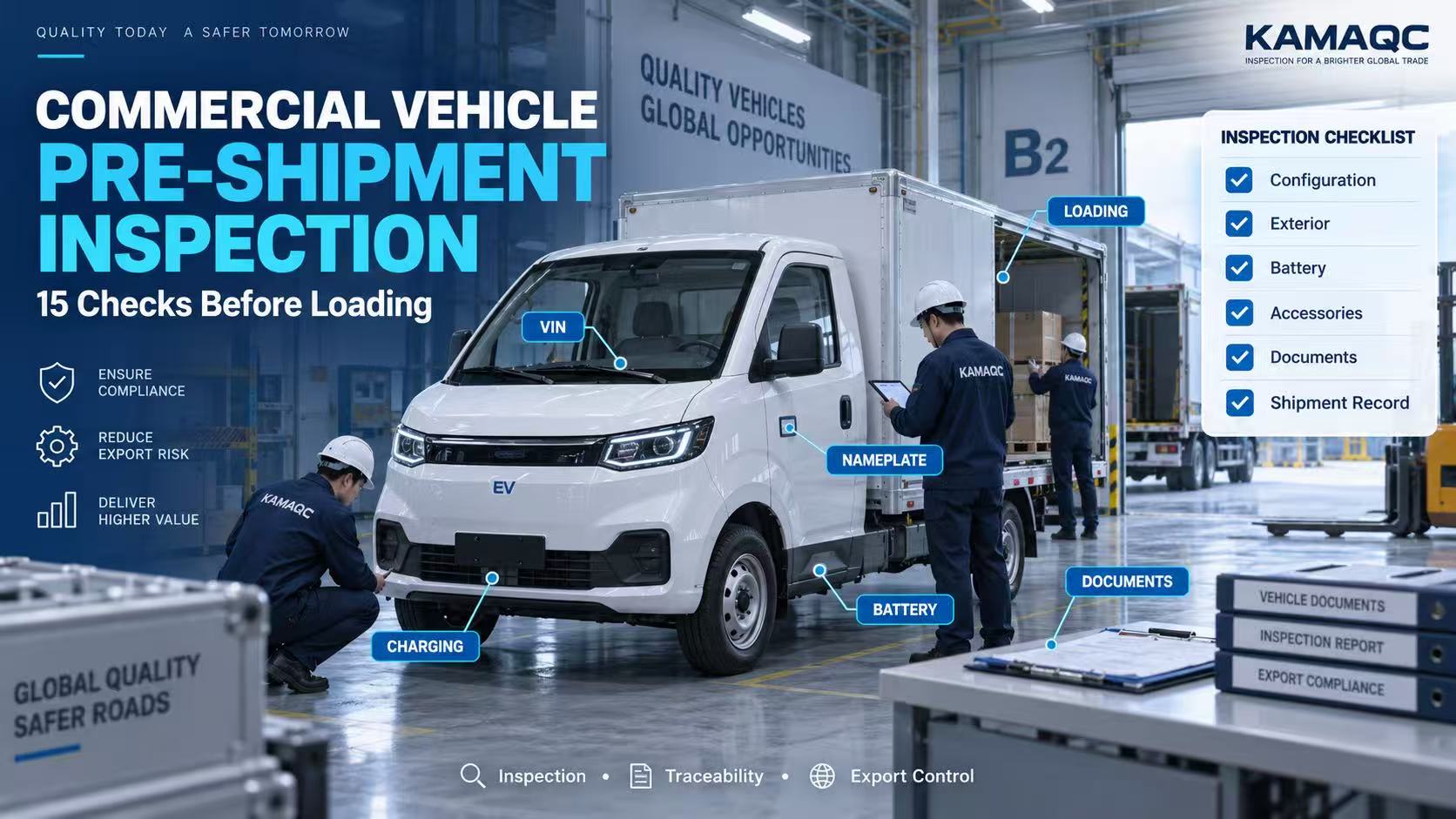
Commercial Vehicle Pre-Shipment Inspection Checklist: 15 Checks Before Loading
Commercial Vehicle Pre-Shipment Inspection Checklist: 15 Checks Before Loading
Importing a commercial vehicle involves more than confirming the model, price and shipping schedule.
Before a truck, cargo van, minibus or electric commercial vehicle leaves the factory, the importer should confirm that the physical vehicle matches the approved order, technical specification and export documents.
A vehicle can look complete while still containing problems such as:
incorrect configuration
VIN mismatch
wrong battery capacity
incorrect charging port
missing accessories
cargo-body differences
document inconsistencies
transport damage
A structured commercial vehicle pre-shipment inspection can help identify these issues before the vehicle is loaded.
For distributors, fleet operators and vehicle importers, the most useful inspection process connects:
Approved Order → Physical Vehicle → VIN → Technical Configuration → Documents → Loading Record
This guide explains 15 practical checks buyers can complete before approving a commercial vehicle for shipment.
1. Start With the Final Approved Vehicle Specification
Every inspection should begin with one controlled reference document.
This may be:
Sales contract
Proforma invoice
Purchase order
Technical agreement
Approved specification sheet
Configuration confirmation
The document should clearly identify the ordered vehicle configuration.
Depending on the vehicle, this can include:
Model
Powertrain
Battery
Engine
Steering position
Cargo body
Seats
Tire specification
Charging interface
Color
Safety equipment
Optional equipment
Importers should not use a general catalogue as the only inspection reference.
One model may have several available configurations.
The inspection should therefore verify the specific vehicle that was ordered.
For batch projects, this becomes especially important when moving from sample approval to volume production. KAMA QC's existing commercial vehicle configuration control guide explains how sample feedback can be converted into a controlled production specification. KAMA出口供应与质量控制中心
2. Verify the Complete VIN
Every vehicle should be connected to a unique VIN or applicable chassis identification number.
The inspector should compare:
Physical VIN
with:
Manufacturer nameplate
with:
Production list
with:
Invoice / VIN schedule
with:
Inspection record
The entire VIN should be checked—not only the last few digits.
For multi-vehicle shipments, prepare one master VIN list before inspection.
Useful fields may include:
VIN
Model
Color
Steering position
Battery / engine
Cargo body
Production date
Container allocation
Inspection status
VIN verification is one of the strongest ways to keep production, inspection and export documents connected.
For a detailed procedure, see the commercial vehicle VIN and nameplate verification checklist. KAMA出口供应与质量控制中心
3. Check the Manufacturer Nameplate
The manufacturer plate should correspond with the approved vehicle configuration.
Depending on the model, it may contain:
Manufacturer
Vehicle model
VIN
Production date
GVW
Axle weight information
Other regulatory information
The inspector should take a readable photograph of the complete plate.
For customized trucks or multi-stage vehicles, body-builder or secondary identification information may also need to be checked according to the vehicle and destination requirements.
4. Verify the Vehicle Model and Configuration
The physical vehicle should match what the buyer approved.
Important checkpoints include:
Steering
LHD or RHD.
Powertrain
Gasoline, diesel, CNG or electric.
Body
Flatbed, box body, refrigerated body, passenger body or dump body.
Seating
Correct passenger-seat layout.
Battery
Correct brand and capacity.
Charging
Correct charging interface.
Safety Equipment
ABS, ESC, airbags or other ordered equipment where applicable.
A model name alone is not enough.
Two vehicles with the same model name may use different batteries, cargo bodies or optional equipment.
5. Inspect the Vehicle Exterior
The exterior inspection should record the condition before loading.
Check:
Paint
Body panels
Doors
Glass
Mirrors
Lamps
Bumpers
Cargo body
Tires
Wheel rims
Look for:
Scratches
Dents
Paint damage
Cracks
Loose parts
Transport or handling damage
Photographs should include multiple angles.
For fleet orders, use a consistent photography method for every VIN.
6. Inspect the Interior and Driver Controls
A commercial vehicle may be mechanically complete while still having missing or damaged cabin equipment.
Inspect:
Seats
Seat belts
Dashboard
Instrument cluster
Steering wheel
Air conditioning
Power windows
Central locking
Multimedia system
Interior trim
Turn the vehicle on and confirm that basic controls operate normally.
Warning lights should be reviewed according to the vehicle's operating condition.
7. Check Vehicle Mileage
Record the odometer reading before shipment.
A new commercial vehicle may have a small amount of mileage from:
production movement
factory testing
PDI
yard movement
loading preparation
The key is transparency.
For batch orders, mileage should be recorded against each VIN.
An unexplained large difference between vehicles should be clarified before shipment.
8. Inspect Tires and Wheels
Check:
Tire specification
Tire brand if contractually specified
Tire size
Visible damage
Tire pressure
Wheel condition
Spare wheel
Commercial vehicles frequently operate under high loads.
The tire specification must therefore match the approved vehicle configuration.
For trucks, also check whether the number of wheels matches the ordered axle and rear-wheel configuration.
9. Inspect Brakes, Steering and Basic Vehicle Functions
A routine functional inspection may include:
Steering operation
Brake response
Parking brake
Lights
Horn
Wipers
Reverse function
Dashboard warnings
The purpose of a pre-shipment inspection is not necessarily to replace formal vehicle testing.
It is to confirm that the completed vehicle operates normally and that obvious faults are not present before release.
10. Check Cargo Body or Passenger Configuration
Commercial vehicle buyers should inspect more than the cab.
For cargo trucks, inspect:
Cargo body dimensions
Floor
Side panels
Tailgate
Locks
Hinges
Mounting points
For box trucks:
Doors
Roof
Panels
Floor
Seals
For passenger vehicles:
Seat quantity
Seat layout
Emergency exits where applicable
Interior trim
Air conditioning
For dump trucks:
Tipper body
Hydraulic mechanism
Hinges
Locking
Subframe connection
The cargo body should match the approved vehicle drawing or confirmed specification.
11. Verify EV Battery Configuration
Electric commercial vehicles require additional checks.
The battery inspection should verify:
Battery manufacturer
Battery-system model
Chemistry
Capacity
Nominal voltage
Serial number
Battery nameplate
Physical condition
The battery installed in the vehicle should match the approved order.
A different battery can affect:
Range
Charging
Vehicle weight
Payload
Registration
Warranty
Battery evidence should be connected to the vehicle VIN.
KAMA QC's detailed electric commercial vehicle battery inspection checklist covers battery nameplates, BMS data, charging tests and supporting documents. KAMA出口供应与质量控制中心
12. Check the Charging Port and Charging Function
For electric vehicles, confirm the physical charging interface.
Examples may include:
GB/T
CCS2
Type 2
Other approved standards
Inspect:
Connector type
Pins
Locking mechanism
Port cover
Charging cable
Adapter if included
A basic charging-function test can confirm that the vehicle and charger communicate.
The inspection should record:
VIN
Charger
Starting SOC
Charging indication
Fault messages
A connector that looks correct does not automatically prove protocol compatibility.
13. Verify Spare Parts, Tools and Accessories
Many export orders include more than the vehicle itself.
Possible items include:
Spare parts
Chargers
Charging cables
Tools
Diagnostic equipment
Spare mirrors
Filters
Brake parts
Wipers
Manuals
The inspector should confirm:
What was ordered
versus:
What is physically included
Take photographs before loading.
If items are packed inside the vehicle, record where they are placed.
14. Cross-Check Export Documents
Physical inspection and document inspection should be connected.
Important documents may include:
Commercial Invoice
Packing List
VIN list
Certificate of Origin
Bill of Lading draft
Vehicle technical documents
Applicable certificates
The model, quantity and vehicle information should remain consistent across all records.
KAMA QC's existing commercial vehicle export documents checklist provides a detailed document-control workflow. KAMA出口供应与质量控制中心
A physically correct vehicle can still face customs or registration delays if the paperwork contains inconsistent information.
15. Record the Loading Process
Inspection should continue through loading.
Record:
VIN of loaded vehicle
Container number
Seal number
Loading position
Vehicle exterior before loading
Accessories
Final closing condition
For electric vehicles, record battery SOC before loading where required by the agreed shipment procedure.
Loading photographs create a final traceable record between:
Vehicle → VIN → Container → Shipment
The existing commercial vehicle container loading plan explains the points importers should confirm before booking and during loading. KAMA出口供应与质量控制中心
Recommended Commercial Vehicle PDI Record
For each vehicle, a practical PDI file can contain:
| Inspection Item | Record |
|---|---|
| VIN | Photo + written record |
| Nameplate | Photo |
| Full exterior | Front / rear / side |
| Interior | Driver cabin |
| Odometer | Dashboard photo |
| Tires | Size + condition |
| Cargo body / seats | Photos |
| Battery | EV models |
| Charging port | EV models |
| Spare parts | Photo |
| Accessories | Photo |
| Inspection date | Recorded |
| Container | Allocation |
| Remarks | Pass / correction required |
For fleet shipments, all records should use a consistent file-naming system.
For example:
VIN – Exterior
VIN – Nameplate
VIN – Battery
VIN – Dashboard
VIN – Loading
This makes the inspection evidence much easier to use after the vehicles arrive.
Common Pre-Shipment Inspection Mistakes
Importers should avoid several common problems.
Only Inspecting One Vehicle in a Batch
One approved sample does not prove every production vehicle matches.
Checking Only Exterior Appearance
A clean vehicle can still contain the wrong battery, configuration or documentation.
Checking Only the Last VIN Digits
Final verification should use the full identification number.
Waiting Until Loading to Find Configuration Errors
Major issues should be identified before the container or vessel booking reaches the final stage.
Keeping Photos Without VIN References
Inspection evidence becomes less useful if nobody can identify which vehicle appears in the photograph.
Treating PDI and Certification as the Same Thing
A pre-shipment inspection confirms the physical order and vehicle condition.
It does not replace destination-market homologation or certification.
Pre-Shipment Inspection vs Factory Quality Control
Factory QC and pre-shipment inspection are related but not identical.
Factory Quality Control
Focuses on whether the vehicle meets production and manufacturing requirements.
Pre-Shipment Inspection
Focuses on whether the actual export vehicle:
matches the buyer's approved configuration
is in acceptable condition
has correct identification
includes the ordered accessories
matches the shipment records
A vehicle can pass factory production QC while still having a commercial configuration mismatch.
For example:
The vehicle may function correctly but use a battery capacity different from the buyer's order.
This is why export-focused verification adds value.
Pre-Shipment Inspection Should Follow the Vehicle Through the Export Process
The strongest quality-control system does not treat inspection as one isolated event.
A better process connects:
Order Confirmation
↓
Configuration Freeze
↓
Production
↓
VIN Assignment
↓
Final Vehicle Inspection
↓
Document Verification
↓
Loading
↓
Shipment Record
This creates traceability throughout the export project.
How KAMA QC Supports Commercial Vehicle Export Inspection
KAMA Export Supply & Quality Control Center supports overseas importers, distributors and fleet buyers with export-oriented vehicle coordination.
Depending on the confirmed vehicle and project scope, support may include:
Vehicle configuration confirmation
VIN verification
Nameplate records
Battery verification
Functional checks
Charging checks
Vehicle photography
Spare-parts confirmation
Export document coordination
Container-loading records
The exact inspection scope should be agreed according to the vehicle, order quantity, destination market and customer requirements.
Frequently Asked Questions
What is a commercial vehicle pre-shipment inspection?
It is a final verification completed before export to confirm that the physical vehicle matches the approved order and that basic condition, configuration, identification and shipment records are correct.
Is pre-shipment inspection the same as factory QC?
No. Factory QC focuses on manufacturing quality, while export PDI also checks the buyer-specific configuration, VIN, accessories and shipment records.
Should every vehicle in a fleet order be inspected?
For important batch orders, key identification and configuration points should preferably be verified for every VIN.
What should be photographed?
Useful records include full vehicle views, VIN, nameplate, dashboard, cargo body or seating, EV battery information where applicable, charging interface and final loading.
Does PDI replace homologation?
No. Pre-shipment inspection does not replace destination-country certification, homologation or registration requirements.
When should inspection take place?
The main vehicle inspection should take place after the final configuration is complete but before shipment documents and loading are finalized.
Planning a Commercial Vehicle Shipment?
Before loading commercial vehicles for export, buyers should confirm:
Destination Country:
Vehicle Model:
Quantity:
Final Configuration:
Battery / Engine:
LHD or RHD:
Cargo Body / Seats:
Required Inspection Records:
Required Certificates:
Destination Port:
A structured inspection plan can then be prepared according to the confirmed order and shipment requirements.