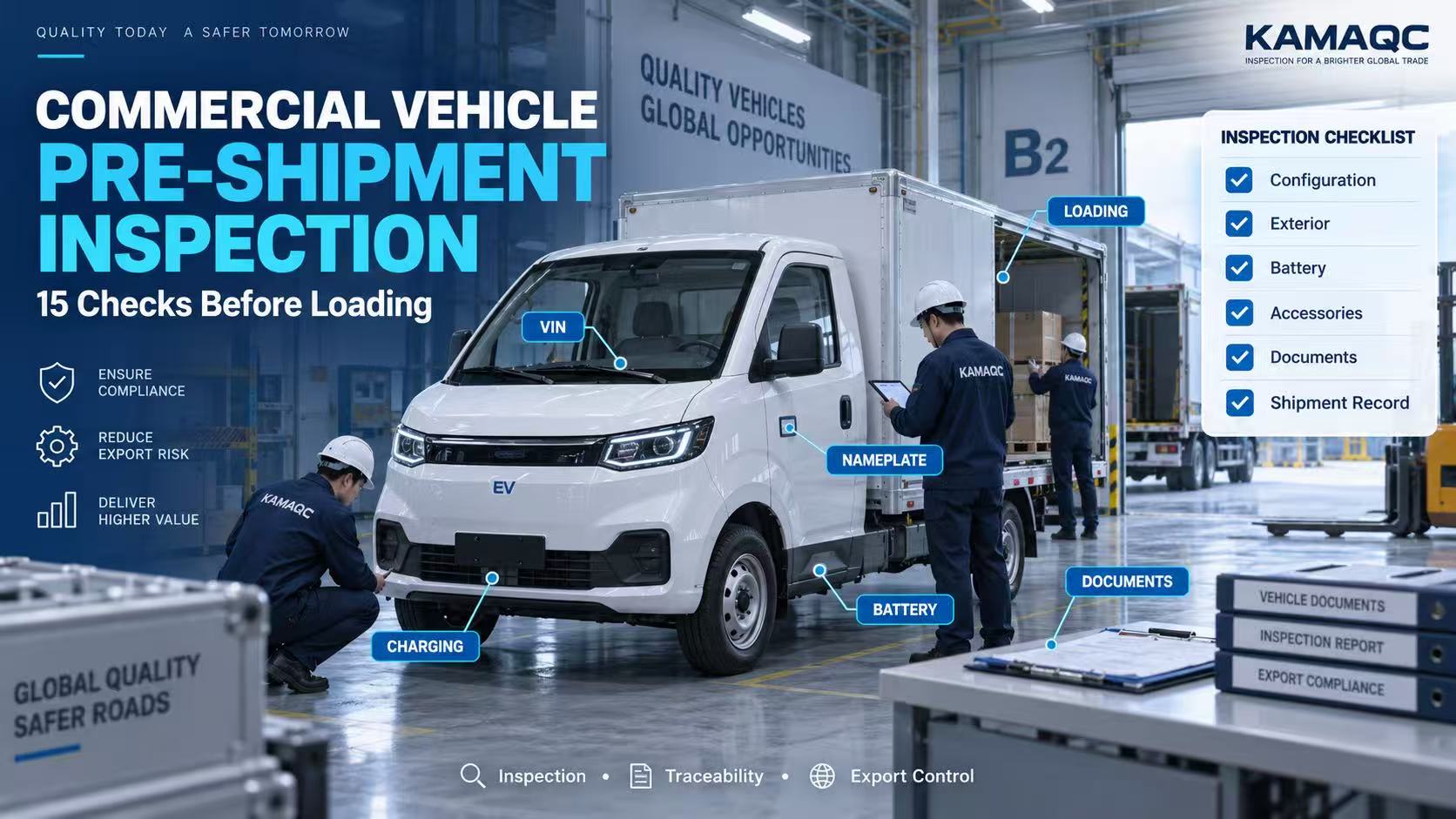
Electric Commercial Vehicle Battery Inspection Before Shipment: A Practical Checklist for Importers
The battery is one of the most valuable and technically important components in an electric commercial vehicle.
For an importer, confirming only the vehicle model and advertised driving range is not sufficient. Before shipment, the buyer should verify that the physical battery installed in the vehicle matches the approved battery brand, chemistry, capacity, voltage, charging standard and technical documentation.
A battery-related error may not always be visible from the exterior of the vehicle. Two vehicles with the same body and model name may use different battery capacities, battery suppliers, cooling systems or charging interfaces.
This is why EV battery inspection should be completed before loading and connected to the VIN of each vehicle.
According to the International Energy Agency’s Global EV Outlook 2026, global EV battery deployment reached approximately 1.2 TWh in 2025, increasing by almost 30% from the previous year. Battery demand from electric trucks more than doubled during the same period.
As electric commercial vehicle exports expand, importers need a structured method for verifying both the battery itself and the documents supplied with it.
Why Battery Verification Matters Before Shipment
A battery discrepancy can affect several parts of an electric vehicle project:
Driving range
Payload
Charging time
Charger compatibility
Vehicle registration
Transport documentation
Warranty coverage
Spare parts planning
Fleet operation
Future battery replacement
For example, an importer may order a vehicle with a 53.58 kWh CATL battery but receive a vehicle carrying a different pack model or capacity. The vehicle may still appear normal, but its range, charging performance, weight and supporting documentation may not match the approved order.
Battery verification creates a connection between four important records:
The battery specified in the purchase order
The physical battery installed in the vehicle
The vehicle and battery technical documents
The inspection evidence connected to the VIN
These four elements should describe the same configuration.
Start with the Approved Vehicle Configuration
The inspection team should first obtain the final approved configuration.
This may be recorded in:
Proforma invoice
Sales contract
Technical agreement
Approved specification sheet
Purchase order
Configuration confirmation
Battery option list
Charging-standard confirmation
The approved configuration should identify, where applicable:
Vehicle model
VIN
Battery brand
Battery-system manufacturer
Battery chemistry
Battery capacity
Nominal voltage
Battery cooling method
Number of battery packs
Charging connector
AC charging capability
DC charging capability
Optional additional battery
Battery warranty
The inspector should not rely only on the vehicle catalogue because catalogues may show several available battery options.
The order-specific technical confirmation should be used as the inspection reference.
Check the Battery Nameplate
The battery nameplate is one of the most important physical identification points.
Depending on the manufacturer and battery design, the nameplate may show:
Battery manufacturer
Battery-system model
Battery pack number
Serial number
Production date
Battery chemistry
Nominal voltage
Rated capacity in ampere-hours
Rated energy in kilowatt-hours
Battery weight
Maximum charging voltage
Safety warning information
Certification or traceability codes
The inspector should take a clear close-up photograph of the full nameplate.
The image should be readable and connected to the vehicle VIN in the inspection report. If a vehicle uses multiple battery packs, the nameplate of each pack should be recorded where accessible and safe.
Do not photograph or touch high-voltage components unless access is permitted and the inspection is performed by qualified personnel.
Verify the Battery Brand Correctly
Battery identification can be more complicated than checking a logo.
An electric vehicle battery system may involve several parties:
Cell manufacturer
Battery module manufacturer
Battery pack manufacturer
Battery-management-system supplier
Vehicle manufacturer or integrator
The cell brand and battery pack manufacturer may not always be the same company.
For example, a vehicle may use cells from one supplier while the complete battery pack is assembled and labelled by another qualified battery-system manufacturer.
Importers should therefore confirm exactly what the contract means by “battery brand.”
The inspection should check:
Cell supplier, if specified
Complete battery-system manufacturer
Battery pack model
Battery serial number
Supporting battery specification
Relationship between the pack manufacturer and the approved battery option
A logo on a catalogue or vehicle screen should not be treated as sufficient evidence of the physical battery configuration.
Verify Battery Capacity
Battery capacity may be expressed in several ways:
Ampere-hours, or Ah
Nominal voltage, or V
Nominal energy, or kWh
Usable energy, or kWh
Total installed energy
Energy per battery pack
A basic nominal-energy calculation is:
Nominal battery energy (kWh) = Nominal voltage (V) × Rated capacity (Ah) ÷ 1,000
For example, a battery rated at 320 V and 168 Ah would have a theoretical nominal energy of approximately:
320 × 168 ÷ 1,000 = 53.76 kWh
The final figure may differ slightly from the commercial description because of rounding, battery configuration and the difference between nominal and usable energy.
When several battery packs are installed, the inspector should determine whether the stated vehicle capacity represents:
One battery pack
The total of several packs
Nominal energy
Usable energy
A rounded commercial value
Importers should avoid comparing an advertised usable-energy figure with a nameplate nominal-energy figure without confirming the definition.
Confirm Battery Chemistry
Commercial electric vehicles commonly use lithium iron phosphate batteries, often described as:
LFP
LiFePO4
Lithium iron phosphate
Other battery chemistries may use different abbreviations.
Battery chemistry matters because it may affect:
Energy density
Vehicle weight
Charging behaviour
Thermal management
Transport documents
Maintenance procedures
Replacement compatibility
The chemistry shown on the battery documentation should match the approved order and physical battery records.
The inspector should not identify the chemistry based only on the expected brand. The actual battery specification or manufacturer documentation should be checked.
Check the Production Date and Serial Number
The battery serial number supports traceability.
Where available, the inspection report should record:
Vehicle VIN
Battery serial number
Battery pack model
Battery production date
Vehicle production date
Motor number
Vehicle controller number, if required
The battery production date should be reviewed together with the vehicle production date and order schedule.
A difference between the two dates is not automatically a problem because batteries may be manufactured before final vehicle assembly. However, a large or unexplained date difference should be clarified before shipment.
Serial numbers should be copied from the physical label or factory record. They should not be entered from memory.
Inspect the Battery Pack’s Physical Condition
The physical battery inspection should be completed by qualified personnel and without opening the battery enclosure.
The inspection may include:
Battery enclosure condition
Visible dents or deformation
Scratches affecting protective coating
Corrosion
Liquid leakage
Loose or missing mounting bolts
Damaged mounting brackets
High-voltage cable condition
Low-voltage communication cable condition
Connector locking
Cooling-pipe condition
Warning-label condition
Signs of impact underneath the vehicle
Abnormal clearance around the battery pack
The battery pack should be securely installed and should not show visible transport, assembly or impact damage.
If liquid cooling is used, the team should check accessible coolant lines and connections for visible leakage. Opening the high-voltage battery enclosure is normally not part of a routine pre-shipment inspection.
Confirm the Battery Cooling System
Battery thermal management may use:
Natural air cooling
Forced-air cooling
Liquid cooling
Heating and cooling systems for cold climates
The approved technical specification should identify the expected thermal-management system where this is commercially important.
For liquid-cooled batteries, the inspection can include:
Coolant level where safely visible
Cooling-pipe condition
Connector condition
Signs of leakage
Diagnostic temperature readings
Cooling-system fault codes
For vehicles intended for high-temperature or cold-climate markets, battery thermal-management capability should be confirmed before production rather than assumed during final inspection.
Review Battery Management System Data
The battery management system, or BMS, monitors the battery pack and communicates with the vehicle.
A diagnostic inspection may record:
State of charge
Battery-system voltage
Battery current
Highest cell voltage
Lowest cell voltage
Cell-voltage difference
Highest battery temperature
Lowest battery temperature
Insulation status
Active fault codes
Historical fault codes, if available
Charging status
Battery serial or software information
The values should be reviewed by a qualified technician because acceptable readings depend on the battery system and operating condition.
A BMS screenshot should be linked to the vehicle VIN and inspection date.
The absence of a dashboard warning light does not replace a diagnostic check when battery verification is part of the agreed inspection scope.
Check Cell-Voltage Consistency
Large differences between individual cell voltages may indicate imbalance, measurement error, an incomplete charge or another condition requiring investigation.
The inspection team should record the highest and lowest cell voltages under a known operating condition.
However, one voltage reading should not be used alone to make a final battery-quality conclusion. The result must be considered together with:
State of charge
Battery temperature
Whether the vehicle is charging
Whether the vehicle was recently operated
Manufacturer limits
Diagnostic fault codes
If the cell-voltage difference falls outside the manufacturer’s accepted range, the battery should be checked before shipment.
Perform a Controlled Charging Test
A charging test confirms that the vehicle, connector, communication system and charger can operate together.
The test should record:
Vehicle VIN
Charger type
Charger identification
AC or DC charging
Connector standard
Starting state of charge
Ending state of charge
Start time
End time
Charging voltage
Charging current
Charging power where available
Dashboard charging indication
Charger display
Fault messages
Abnormal heat, noise or smell
The purpose of a short pre-shipment test is normally to confirm charging communication and basic operation. It is not necessarily a complete 0–100% charging-time test.
The charging connector should match the approved order, such as GB/T, Type 2, CCS2 or another confirmed standard.
A connector that physically fits does not automatically confirm full protocol compatibility.
Inspect the Charging Port and Cable
The charging interface should be examined for:
Correct connector type
Clean and undamaged pins
No visible corrosion
No bent contacts
Port-cover operation
Locking function
Cable condition
Protective caps
Water and dust protection
Warning labels
Charging cable included in the order
If an adapter is supplied, it should be recorded separately and tested with the approved vehicle and charger where possible.
The inspection report should clearly distinguish between:
Factory-installed charging inlet
External charging cable
Portable charger
DC charger
Charging adapter
Check Battery State of Charge Before Loading
The battery state of charge should be recorded before the vehicle is loaded.
The required shipping state of charge may depend on:
Shipping line
Freight forwarder
Transport mode
Port requirements
Vehicle condition
Battery type
Whether the battery is installed in a vehicle
Whether spare batteries are shipped separately
Importers should not assume that one state-of-charge limit applies to every shipment.
The exporter and freight forwarder should confirm the current carrier requirements before loading. The inspection report should record the actual dashboard or diagnostic state of charge.
Verify the UN 38.3 Test Summary
Lithium battery manufacturers and subsequent distributors are generally required to make available a test summary demonstrating that the battery type has met the applicable requirements of the UN Manual of Tests and Criteria, Part III, subsection 38.3.
The International Air Transport Association explains that the test-summary requirement applies to lithium cells and batteries, including batteries installed in equipment. Actual transport requirements can still vary by mode, carrier and operator.
An importer reviewing a UN 38.3 test summary should check:
Battery manufacturer’s name
Manufacturer’s contact information
Test laboratory
Laboratory contact information
Test-report identification number
Test-report date
Battery model or type
Physical description
Battery mass
Watt-hour rating
List of completed tests
Confirmation of test results
Edition or revision of the UN Manual used
Name and position of the responsible signatory
Signature or equivalent authentication
Most importantly, the battery model shown on the test summary should match the battery model installed in the vehicle or be clearly traceable to it.
A UN 38.3 test summary for a different battery model should not be accepted simply because it comes from the same manufacturer.
Understand What UN 38.3 Does Not Prove
UN 38.3 is a transport-related battery test requirement. It should not be treated as proof of every aspect of vehicle or battery quality.
A UN 38.3 test summary does not by itself confirm:
Current state of battery health
Vehicle driving range
Battery warranty
Vehicle homologation
Local registration compliance
Charging-network compatibility
Battery capacity installed in a specific VIN
Absence of physical damage
Absence of BMS fault codes
Complete vehicle safety certification
This is why document verification and physical inspection must be used together.
Review Additional Battery Documents
Depending on the order, carrier and destination, additional documents may include:
Battery specification sheet
Safety Data Sheet
Battery-system drawing
Battery manufacturer declaration
UN 38.3 test summary
Transport information requested by the carrier
Battery warranty statement
Battery serial-number list
Charging instruction
Emergency-response information
Battery maintenance instruction
Certificate or test report required by the destination market
Not every document is required for every shipment.
The buyer should confirm destination requirements with its local customs broker, certification agency and registration authority. The exporter should confirm transport requirements with the freight forwarder and carrier.
Match Battery Evidence to Each VIN
Inspection evidence becomes much more useful when it can be traced to an individual vehicle.
For each VIN, the battery inspection file may contain:
Full vehicle photograph
VIN plate photograph
Battery nameplate photograph
Battery serial number
BMS diagnostic screenshot
Dashboard state-of-charge photograph
Charging-port photograph
Charging-test photograph or video
Battery underside photograph
Inspection date
Inspector identification
For multiple-vehicle orders, files should use a consistent naming method.
For example:
VIN – Battery Nameplate
VIN – BMS Data
VIN – Charging Test
VIN – Battery Condition
This helps the importer identify which evidence belongs to each vehicle.
Five-Point Battery Consistency Check
Before approving shipment, the importer should complete five final checks.
1. Order Consistency
Does the battery match the brand, chemistry, capacity and cooling system specified in the approved order?
2. Physical Consistency
Does the battery nameplate and serial number match the inspected vehicle and factory record?
3. Technical Consistency
Do the nominal voltage, rated capacity and energy calculation agree with the technical specification?
4. Document Consistency
Does the UN 38.3 test summary and battery specification identify the correct battery model?
5. Functional Consistency
Did the vehicle complete the agreed charging and diagnostic checks without unresolved battery-system faults?
Shipment should be approved only after any inconsistencies have been explained and recorded.
Common Battery Verification Mistakes
Checking Only the Dashboard Range
Dashboard range is an estimate affected by software, state of charge, temperature and previous driving behaviour. It does not prove the installed battery capacity.
Checking Only the Battery Brand
A brand name does not identify the exact battery model, capacity or pack configuration.
Accepting a Generic Test Report
The battery model on the report must be connected to the battery installed in the vehicle.
Ignoring Multiple Battery Packs
If the vehicle uses more than one pack, the total installed energy and the identification of each pack should be confirmed.
Confusing Nominal and Usable Energy
A nominal battery figure and usable-energy figure may be different. Buyers should confirm which value is being advertised.
Failing to Connect Evidence to the VIN
Unlabelled photographs cannot reliably prove which battery was installed in which vehicle.
Treating a Short Charging Test as a Capacity Test
A short charging test confirms basic charging operation. It does not independently measure the battery’s complete usable capacity.
How KAMA QC Supports Battery Verification
KAMA Export Supply & Quality Control Center supports overseas importers, distributors and fleet buyers during vehicle configuration, inspection and shipment coordination.
Depending on the order and agreed inspection scope, support may include:
Vehicle configuration confirmation
VIN verification
Battery nameplate recording
Battery brand and model checking
Battery-capacity cross-check
Battery serial-number recording
Exterior battery inspection
Dashboard and BMS record
Charging-interface confirmation
Charging-function test
Battery document coordination
Inspection photographs and videos
State-of-charge recording
Container-loading supervision
Shipping-document coordination
The exact documents and inspection items available depend on the vehicle, battery system, destination, carrier requirements and agreed order scope.
Information Buyers Should Provide
To prepare a battery inspection and document-verification plan, buyers should provide:
Destination country
Vehicle model
Order quantity
Required battery brand
Required battery capacity
Battery chemistry
Charging standard
AC and DC charging requirements
Required technical documents
Destination certification requirements
Carrier or freight-forwarder requirements
Special inspection requirements
Expected shipment date
These requirements should be confirmed before production and not added only after loading has been arranged.
Conclusion
An electric commercial vehicle battery should be verified through physical identification, technical data, diagnostic information, charging performance and supporting documents.
The most reliable inspection process connects:
Vehicle VIN
Battery nameplate
Battery serial number
Approved configuration
BMS data
Charging test
UN 38.3 test summary
Inspection report
No single photograph or certificate can replace the complete verification process.
For importers, completing these checks before shipment can reduce configuration disputes, charging problems, documentation corrections and post-arrival uncertainty.
If you are purchasing electric mini trucks, electric vans or electric light trucks, KAMA QC can help coordinate vehicle inspection, battery verification, document checking and shipment records according to the confirmed order scope.
Frequently Asked Questions
What should be checked during an EV battery inspection?
The inspection should verify the battery nameplate, manufacturer, model, chemistry, capacity, serial number, physical condition, BMS data, charging interface and supporting documents.
How can an importer confirm battery capacity?
Compare the approved order with the battery nameplate, nominal voltage, rated ampere-hours, technical specification and battery pack configuration. Nominal energy can be estimated by multiplying voltage by ampere-hours and dividing by 1,000.
Does a UN 38.3 test summary prove battery quality?
No. It provides evidence that the battery type has completed specified transport tests. It does not independently prove current battery health, installed capacity, vehicle range, warranty or vehicle homologation.
Should every vehicle have separate battery inspection evidence?
For a multi-vehicle order, battery photographs, serial numbers, BMS records and charging-test evidence should preferably be connected to each VIN.
Is a charging test the same as a battery-capacity test?
No. A short charging test confirms communication and charging operation. It does not independently measure the complete usable battery capacity.
Can inspectors open the battery enclosure?
Routine pre-shipment inspection should not involve opening a high-voltage battery enclosure. Battery work should only be performed by qualified personnel following the manufacturer’s safety procedures.
What documents may be required for an EV battery shipment?
Depending on the carrier and destination, documents may include a battery specification, Safety Data Sheet, UN 38.3 test summary, battery manufacturer information and transport information requested by the carrier.