Electric Light Truck Specifications: A Buyer’s Guide
How to Compare Electric Light Truck Specifications Before Importing
Importers often receive several quotations that appear to describe similar vehicles, yet the specification sheets may use different definitions, test cycles and body configurations. Comparing only battery capacity or advertised range can therefore produce the wrong conclusion. A reliable review of electric light truck specifications should connect payload, gross vehicle weight, battery, motor, charging, cargo body and local operating conditions.
This guide explains how overseas distributors, fleet buyers and project purchasers can compare electric light trucks before approving a model or placing an order. It does not recommend one universal configuration. The correct vehicle depends on the destination country, route, cargo, climate, charging environment and registration rules.
Contents
Start with the operating route
Understand curb weight, payload and GVW
Compare battery capacity correctly
Check the range test method
Review motor, axle, tyres and gradeability
Confirm charging compatibility
Calculate the effect of the cargo body
Verify the final specification before ordering
Prepare a useful inquiry for the supplier
1. Start with the Operating Route, Not the Largest Battery
The first step is to describe the daily transport task. A larger battery may extend the declared range, but it can also add weight, occupy chassis space and affect payload economics. The best specification is the one that completes the required route with a practical reserve while carrying the intended cargo.
Before comparing models, record the expected daily mileage, number of trips, average and maximum payload, road gradient, traffic pattern, average speed and available charging time. A truck that travels 80 km per day on a fixed urban route has different requirements from one that must cover 220 km between regional distribution points.
The cargo type also matters. Parcel delivery may require a large enclosed body with moderate weight, while beverages, construction materials or agricultural products may require higher axle capacity and a stronger flatbed. Refrigerated transport adds body weight and continuous electrical demand. Repeated hill climbing, rough roads, high ambient temperature or cold weather can further change energy consumption.
Importers should therefore prepare an operating profile before asking for a quotation. This helps the supplier recommend a suitable model and makes different quotations easier to compare on the same basis.
2. Understand Curb Weight, Payload and GVW
Three weight terms are essential when reviewing an electric truck.
Curb weight is the weight of the completed vehicle in the stated condition, normally including the installed battery and standard equipment.
Payload is the load the vehicle can carry under the approved configuration.
Gross vehicle weight (GVW) is the maximum permitted total weight of the vehicle, occupants, cargo and installed equipment.
A basic reference calculation is:
Payload = GVW − final curb weight
However, the final curb weight must match the exact vehicle being purchased. A bare chassis, a flatbed truck, an enclosed van body and a refrigerated truck can have very different curb weights even when they use the same chassis. A tail lift, refrigeration unit, additional battery, reinforced body, spare wheel or other accessory can reduce the remaining legal payload.
For example, a quotation may advertise a three-ton payload based on a standard flatbed. If the buyer changes to a heavy insulated body and installs a hydraulic tail lift, the finished vehicle may no longer provide the same available payload. The supplier should recalculate the final curb weight and payload after the body design is confirmed.
Buyers should also request front and rear axle ratings. Total GVW alone does not show whether the load is distributed correctly. A long cargo body or concentrated rear load can overload one axle even when the vehicle remains below its total GVW.
3. How to Read Electric Light Truck Battery Specifications
Battery capacity is normally shown in kilowatt-hours, but the largest number is not automatically the best choice. Confirm whether the figure is nominal or usable capacity, identify the battery chemistry and manufacturer, and review thermal management.
The evaluation should cover the approved cell or pack supplier, rated voltage, pack capacity, cooling method, battery protection and available technical documents. Liquid cooling can support repeated operation and fast charging, while battery heating may be relevant in cold markets.
Ask the supplier to confirm:
Battery manufacturer and chemistry
Rated and usable capacity, where available
Rated system voltage
Cooling and heating method
Battery pack location and protection
Battery management system functions
Applicable battery transport and test documents
Effect of an optional battery on curb weight and payload
An additional battery can improve route flexibility, but its weight must be included in the finished vehicle calculation. The modification may also affect charging time, axle load, cargo-body installation and certification. It should never be treated as a simple range upgrade without a complete technical review.
4. Compare Electric Truck Driving Range on the Same Basis
Range figures are useful only when their test method and conditions are clear. NEDC, CLTC, WLTP and manufacturer-declared operating range are not interchangeable. Two trucks with similar battery capacity may show very different published ranges because they were tested under different cycles, vehicle loads, speeds or environmental conditions.
When comparing electric truck driving range, ask five questions:
Which test cycle was used?
Was the truck tested empty, partially loaded or fully loaded?
Which cargo body was installed?
What were the temperature, speed and road conditions?
Does the figure represent laboratory testing or a real route?
Actual range can change with payload, average speed, road gradient, traffic, temperature, tyre pressure, air-conditioning or heating, cargo-body aerodynamics and driving behaviour. For this reason, the purchasing decision should include a route reserve instead of assuming the published maximum will be available every day.
For a fleet project, request a range estimate based on the intended payload and route. If possible, complete a sample test before a large order. Record starting state of charge, route distance, payload, temperature, average speed and ending state of charge. This produces a more useful benchmark than an unsupported range claim.
5. Check Motor, Axle, Tyres and Gradeability Together
Peak motor power should not be reviewed alone. Rated power, peak power, maximum torque, drive-axle ratio, tyre size and vehicle weight work together. A strong peak figure is insufficient if continuous output, axle selection or cooling does not match the route.
For urban distribution, repeated starts and stops require responsive low-speed performance. For hilly areas, gradeability under load is more important than an unloaded demonstration. Rural and construction routes may require stronger tyres, adequate ground clearance and a chassis designed for uneven surfaces.
Buyers should compare:
Rated and peak motor power
Motor and controller manufacturer
Maximum torque, if available
Drive configuration and final-drive ratio
Gradeability and test condition
Front and rear axle ratings
Single or dual rear wheels
Tyre size and commercial load rating
Braking and steering systems
Ground clearance and suspension arrangement
Check these items against the cargo and route. A commercial truck must move the required load repeatedly, not only reach a maximum speed when empty.
6. Confirm the Charging Standard and Charging Window
Charging compatibility is part of the vehicle specification, not an accessory decision to leave until shipment. The connector, vehicle inlet, on-board charger, DC charging capability, voltage range and local charging equipment must work together.
Different markets may use GB/T, CCS2 or another charging standard. A physical adapter does not automatically guarantee full electrical or communication compatibility. Before ordering, the buyer should provide the destination country, local grid conditions, required AC input, expected DC charger output and preferred charging location.
Also calculate the charging window. Overnight depot charging differs from recharging between daytime shifts. Battery temperature, charger output and initial state of charge can affect the result.
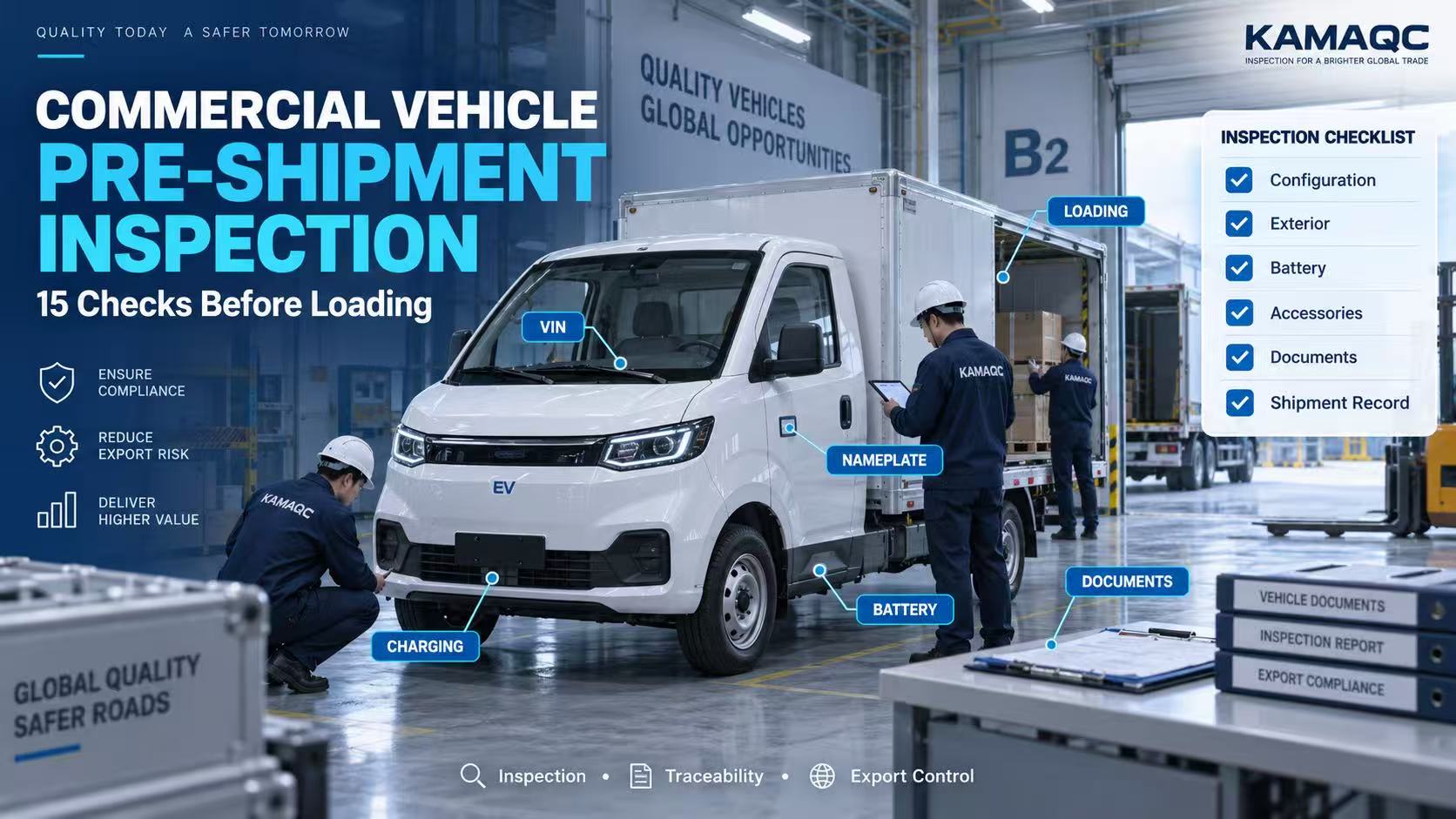
Confirm included and optional charging equipment and local installation responsibility. For a first shipment, record the port type, cable, charger details, connector photographs and a basic charging test. KAMA QC’s spare-parts and charging checklist provides a separate pre-shipment review.
7. Include the Cargo Body in the Specification Comparison
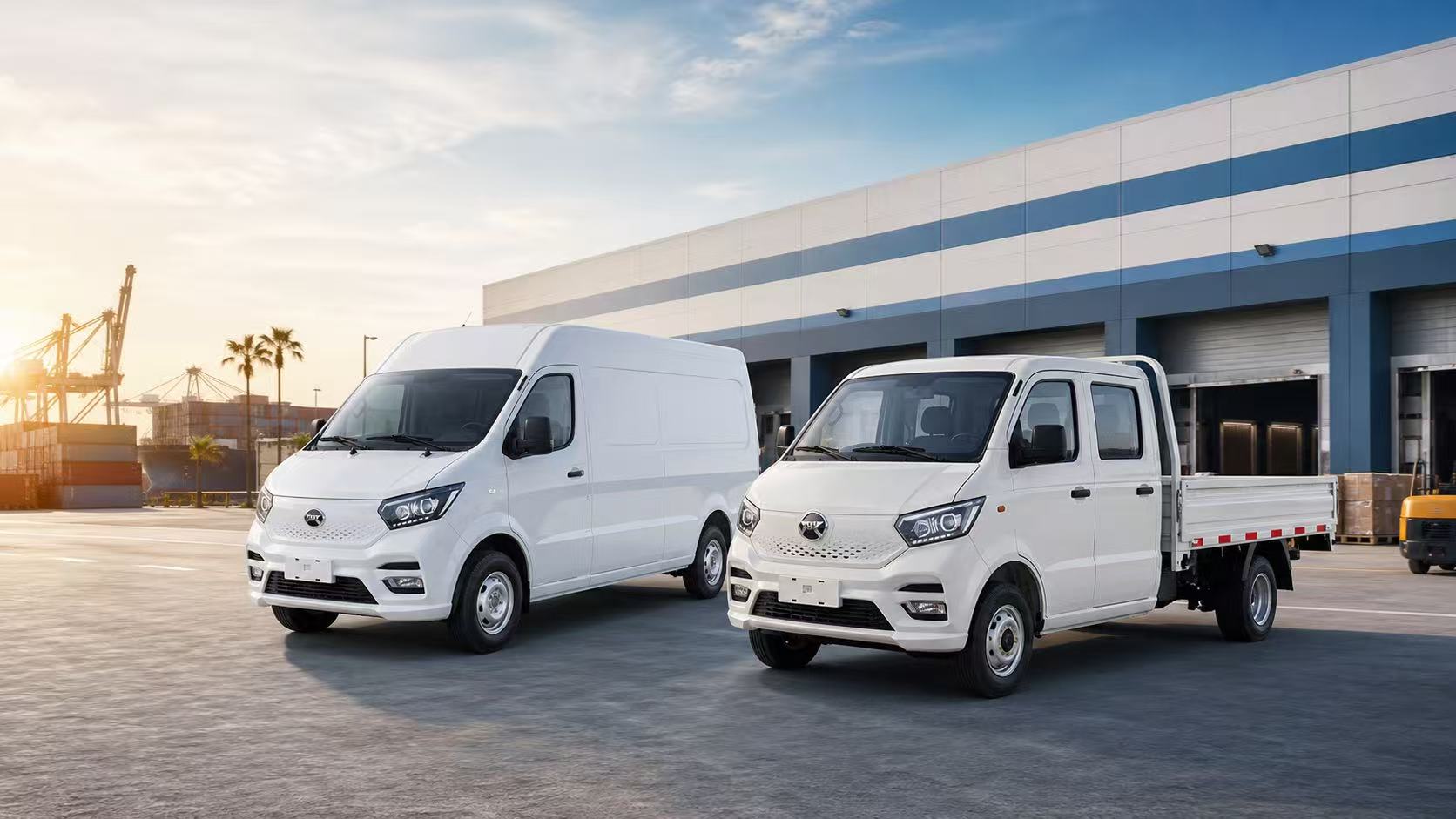
The cargo body changes more than appearance. It affects curb weight, payload, external dimensions, aerodynamics, energy consumption, axle distribution and loading efficiency. A flatbed, box body, refrigerated body and special-purpose conversion should therefore be treated as different finished-vehicle configurations.
For a flatbed, confirm internal dimensions, floor material, side-panel height, tie-down points and body weight. For an enclosed box, review internal volume, door arrangement, floor strength, water resistance and body material. For refrigerated transport, add insulation thickness, temperature requirement, refrigeration-unit power demand and the weight of the complete cooling system.
The buyer should receive a body drawing before production. The drawing should show overall dimensions, usable internal dimensions, mounting position and key materials. Any tail lift, toolbox, spare wheel, side guard or additional battery should also appear in the final layout.
After the design is approved, request the finished curb weight and payload calculation again. This is especially important when comparing quotations from suppliers that show a chassis specification in one table and a completed-vehicle photo in another.
Buyers can review KAMA QC’s electric light-duty truck range and EV mini truck range to identify the appropriate vehicle class before confirming a body type.
8. Verify One Final Specification Before Ordering
During a project, buyers may receive a brochure, quotation, drawing, certificate and technical sheet at different times. These documents should describe the same final vehicle. Mixing data from several variants is a common source of procurement risk.
Create one approved specification sheet that records:
Vehicle model and steering position
Drive configuration and wheelbase
Overall and cargo-body dimensions
Final curb weight, payload and GVW
Front and rear axle ratings
Battery manufacturer, chemistry and capacity
Motor and controller details
Range figure and test standard
Charging interface and AC/DC capability
Tyres, brakes, steering and safety equipment
Cabin equipment and language requirements
Ordered accessories and spare parts
Required documents and certification scope
Do not assume that a certificate for one battery, steering position or body version automatically covers another. Destination-country registration and certification requirements should be checked with the local authority or professional service provider before the order is finalized.
Before shipment, use the approved sheet during VIN checking and pre-delivery inspection. The vehicle, nameplate, documents and ordered accessories should remain consistent. For additional supplier verification, see How to Verify a Commercial Vehicle Manufacturer in China.
9. Send the Supplier a Complete Operating Requirement
A useful inquiry allows the supplier to recommend a configuration instead of sending a generic price list. Provide the following information:
Destination country and port
Required quantity
Left-hand drive or right-hand drive
Main cargo and body type
Average and maximum payload
Daily route and longest trip
Urban, regional, rural or hilly operation
Local temperature range
Charging standard and available charger
Required delivery or project schedule
CBU, SKD or CKD preference
Local certification or document requirements
KAMA Export Supply & Quality Control Center can discuss vehicle selection, configuration checking, inspection preparation, export documentation and shipment coordination according to the confirmed model and project. Final specifications, availability, certification scope, order terms and production schedule require factory and sales-team confirmation.
If you are evaluating an electric mini truck or electric light truck, contact KAMA QC with the operating information above. A route-based specification comparison can reduce uncertainty before quotation and help the buyer compare suitable configurations on the same basis.
Conclusion
The best way to compare electric light truck specifications is to connect every number to the finished vehicle and its real operating route. Payload must be calculated from final curb weight and GVW. Battery capacity must be reviewed with thermal management and added weight. Range must use a stated test method, while charging, axle ratings, tyres and cargo-body design must match the destination market.
Importers who approve one complete technical specification before ordering are better positioned to compare suppliers, plan local operation and inspect the delivered vehicle. The objective is not to choose the largest battery or the longest advertised range; it is to select a commercial vehicle that can carry the required cargo, complete the route and be supported in the target market.
Frequently Asked Questions
What are the most important electric light truck specifications?
The main specifications are final payload, curb weight, GVW, axle ratings, battery capacity and thermal management, motor output, declared range and test cycle, charging interface, cargo-body dimensions, tyre specification and braking system.
How is electric truck payload calculated?
As a basic reference, payload equals GVW minus the final curb weight. The calculation must use the completed vehicle, including its battery, cargo body, tail lift, refrigeration unit, spare wheel and other installed equipment.
Does a larger battery always give an electric truck more useful range?
Not automatically. A larger battery can increase stored energy, but it also adds weight and may affect payload, axle load and charging time. Useful range depends on the complete vehicle, load, route, speed, climate and test method.
Can NEDC, CLTC and WLTP range figures be compared directly?
No. They use different test procedures and should not be treated as equivalent. Compare vehicles using the same test cycle and request an estimate or route test based on the intended payload and operating conditions.
What information is needed before requesting an electric light truck quotation?
Provide the destination country and port, quantity, steering position, cargo type, body requirement, payload, daily mileage, road and climate conditions, charging standard, certification needs and CBU, SKD or CKD preference.
Recommended Internal Links
| Anchor text | URL | Placement |
| electric light-duty truck range | https://www.kamaqc.cn/light-duty-trucks/ | Cargo-body section |
| EV mini truck range | https://www.kamaqc.cn/ev-mini-trucks/ | Cargo-body section |
| spare-parts and charging checklist | https://www.kamaqc.cn/news/electric-commercial-vehicle-spare-parts-charging-checklist/ | Charging section |
| verify a commercial vehicle manufacturer in China | https://www.kamaqc.cn/news/verify-commercial-vehicle-manufacturer-china/ | Final-specification section |
| contact KAMA QC | https://www.kamaqc.cn/contacus/ | CTA |