Commercial Vehicle Export Documents Checklist: What Importers Should Verify Before Shipment
Commercial Vehicle Export Documents Checklist: What Importers Should Verify Before Shipment
Importing commercial vehicles involves much more than selecting a model, confirming a price and arranging ocean freight. Before the vehicles leave the factory, importers must make sure that the commercial invoice, packing list, VIN records, shipping instructions and supporting certificates all describe the same vehicles and the same transaction.
A vehicle may pass its physical inspection and still face customs delays if the documents contain inconsistent model names, incorrect VIN numbers, different consignee information or missing technical records.
For distributors, fleet operators and project buyers, a structured commercial vehicle export documents checklist can reduce unnecessary corrections, port delays and registration problems after arrival.
Why Export Document Verification Matters
Commercial vehicle shipments involve several parties:
Vehicle manufacturer
Export company
Overseas buyer
Freight forwarder
Shipping line
Customs broker
Inspection company
Destination customs authority
Local vehicle registration authority
Each party may use information from the same document package. A small inconsistency can therefore create problems at multiple stages.
For example, if the VIN shown on the packing list does not match the physical vehicle, the importer may have difficulty completing customs clearance or local registration. If the consignee name on the bill of lading differs from the buyer’s approved company name, the shipping document may need to be amended.
The best time to identify these problems is before loading and before the final shipping documents are issued.
1. Proforma Invoice and Sales Contract
The proforma invoice normally establishes the basic commercial terms before production or shipment begins.
Importers should verify:
Seller’s full legal company name
Buyer’s full legal company name
Vehicle model and configuration
Quantity
Unit price and total value
Currency
Payment terms
Incoterm, such as FOB or CFR
Port of loading
Destination port
Estimated production or delivery period
Warranty terms
Optional equipment
Spare parts included in the order
The model description should be detailed enough to distinguish between different configurations.
For an electric commercial vehicle, the description may also include:
Left-hand drive or right-hand drive
Battery capacity
Battery supplier
Cargo or passenger configuration
Number of seats
Charging connector
Cargo body type
Air-conditioning
Fast-charging option
The approved proforma invoice should become the reference document for production, inspection and final shipment preparation.
2. Commercial Invoice
The commercial invoice is one of the main documents used during customs clearance. It identifies the goods being sold, their declared value and the parties involved in the transaction.
Before shipment, buyers should check that the commercial invoice includes:
Exporter information
Importer or buyer information
Invoice number and date
Vehicle description
Vehicle quantity
Unit price
Total amount
Currency
Incoterm
Country of origin
Port information
Payment information where required
Vehicle descriptions should remain consistent with the proforma invoice, packing list and shipping instructions.
Avoid using one model description on the commercial invoice and a completely different description on the packing list. Even when both descriptions refer to the same vehicle, customs officers may request clarification when the wording is inconsistent.
3. Packing List and VIN List
For vehicle shipments, the packing list should identify exactly what is being loaded.
Depending on the shipment, it may include:
Number of vehicles
Vehicle model
VIN or chassis number
Engine number for fuel vehicles, where applicable
Motor number for electric vehicles, where applicable
Vehicle dimensions
Net weight
Gross weight
Container number
Spare parts packages
Charging equipment
Tool kits
Additional accessories
The VIN list is one of the most important parts of the document package.
Each VIN should be checked against:
The VIN plate on the physical vehicle
The commercial invoice or attached VIN schedule
The packing list
The inspection report
The bill of lading draft when VINs are shown
Any destination registration documents prepared before shipment
A single incorrect character can cause problems. VINs should therefore be copied from the vehicle identification plate or factory record rather than entered manually from memory.
4. Bill of Lading Draft
The bill of lading is issued by the carrier and records the transport arrangement. Importers should review the draft before the final bill of lading is released.
Important information includes:
Shipper
Consignee
Notify party
Port of loading
Port of discharge
Final destination, where applicable
Vessel and voyage information
Cargo description
Number of vehicles or packages
Container number
Seal number
Gross weight
Freight terms
The consignee and notify-party details must follow the buyer’s instructions exactly.
Company names, addresses and registration details should not be abbreviated unless the buyer and customs broker have approved the format.
The cargo quantity on the bill of lading must also agree with the commercial invoice and packing list.
5. Certificate of Origin
A certificate of origin confirms the manufacturing origin of the vehicles. Some destination markets require this document for customs clearance, tariff treatment or import registration.
Importers should confirm:
Whether a certificate of origin is required
Which organization must issue or certify it
Whether a specific format is required
Whether the vehicle description matches the commercial invoice
Whether the invoice number and date are correct
Whether the exporter and consignee information is consistent
The destination country may require additional authentication, legalization or chamber certification. These requirements should be confirmed before shipment because post-shipment corrections can be difficult.
6. Technical Specification and Compliance Documents
Commercial vehicles may require technical documents for customs inspection, homologation, registration or customer handover.
Depending on the market and vehicle type, the document package may include:
Vehicle specification sheet
Dimension and weight information
Battery specification
Motor specification
Engine specification
Emission information
Charging connector information
Seating layout
Brake and safety configuration
Certificate of conformity
Component certificates
Test reports
Manufacturer declaration
Warranty document
Owner’s manual
Maintenance manual
Not every document is required in every market.
Importers should check local requirements with their customs broker, certification agency or registration authority before placing the order. A certificate accepted in one country may not be sufficient in another country.
7. Pre-Shipment Inspection Report
A pre-shipment inspection report provides evidence that the vehicles were checked before loading.
A practical report may include:
VIN verification
Model and configuration confirmation
Exterior inspection photos
Interior inspection photos
Dashboard and mileage record
Battery state-of-charge record
Charging test
Lighting test
Brake and steering check
Cargo body inspection
Optional equipment confirmation
Spare parts confirmation
Container loading photos
Container number and seal number
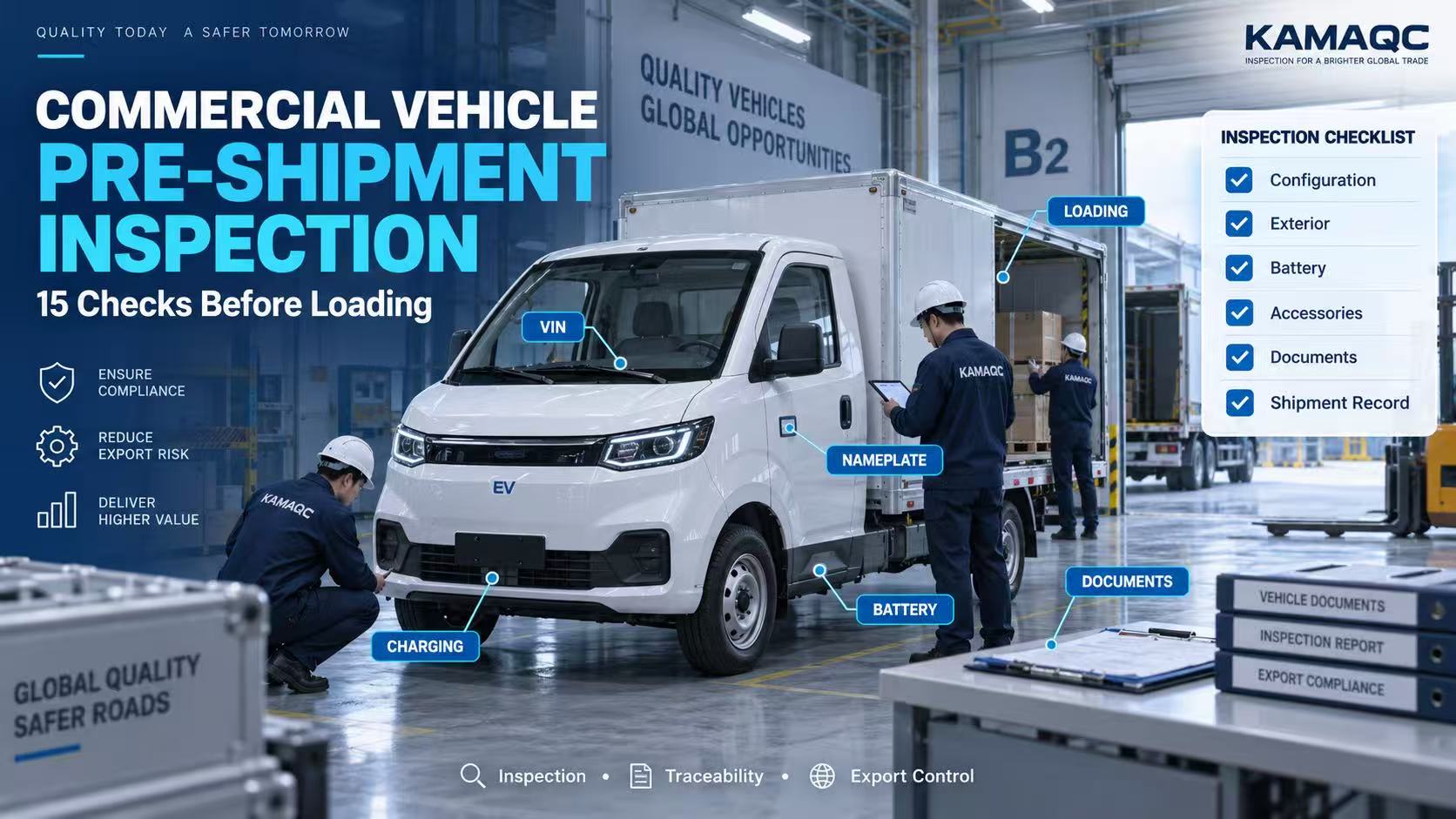
For electric commercial vehicles, the inspection should also confirm that the battery, motor, charging interface and vehicle control systems match the agreed configuration.
The inspection report should be connected to the VIN list so the buyer can identify which photos and results belong to each vehicle.
8. Additional Documents for Electric Commercial Vehicles
Electric vehicle shipments may require additional battery and transport information.
Depending on the shipping line, transport mode, destination and vehicle configuration, the requested documents may include:
Battery specification sheet
Safety Data Sheet
UN 38.3 test summary
Battery manufacturer information
Battery type and chemistry
Rated battery capacity
Battery condition declaration
Vehicle state-of-charge record
Dangerous-goods information requested by the carrier
Emergency contact information
Importers should not assume that every carrier applies exactly the same document process.
The exporter, freight forwarder and shipping line should confirm the applicable requirements before booking. This is especially important when spare battery packs, separate charging equipment or battery-containing spare parts are shipped together with the vehicles.
The Five-Point Consistency Check
Before approving the final document package, buyers should perform a five-point consistency check.
1. Company Information
Confirm that the exporter, buyer, consignee and notify party are shown correctly on all relevant documents.
2. Vehicle Identity
Confirm that the model, VIN, engine number or motor number matches the physical vehicle and inspection records.
3. Quantity
Confirm that the invoice, packing list, VIN schedule and bill of lading show the same number of vehicles and packages.
4. Financial Information
Confirm that the price, currency, total amount and Incoterm match the approved transaction.
5. Shipping Information
Confirm the port of loading, destination port, container number, seal number and freight terms.
These checks should be completed before the final bill of lading and original certificate documents are issued.
Common Export Document Mistakes
The most common problems are often simple administrative errors.
Incorrect VIN Characters
The letters and numbers in a VIN can easily be mistyped. Every VIN should be checked character by character.
Different Model Names
The sales team, factory and freight forwarder may use different model descriptions. A standard description should be agreed before shipping documents are prepared.
Incorrect Buyer Name
The buyer’s trading name may differ from its legally registered company name. Customs documents should normally use the approved legal entity.
Mismatched Quantity or Weight
The packing list and bill of lading may show different quantities or gross weights if information is updated during loading but not corrected in all documents.
Unapproved Bill of Lading Details
A shipping line may issue the final bill of lading based on an unverified draft. The importer should approve the consignee, notify party and cargo description before issuance.
Missing Destination-Specific Documents
Some markets require inspection certificates, conformity documents, legalized invoices or special import approvals. These should be confirmed before production or shipment.
Recommended Document Workflow for Importers
A controlled document process can be divided into seven stages.
Stage 1: Confirm Destination Requirements
Ask the local customs broker or registration authority which documents and certifications are required.
Stage 2: Approve the Proforma Invoice
Confirm the commercial terms, vehicle configuration and company information.
Stage 3: Freeze the Vehicle Configuration
Record the final battery, steering position, seats, cargo body, charging interface and optional equipment.
Stage 4: Receive the VIN List
Check the VIN list against the vehicle specification and production records.
Stage 5: Review the Pre-Shipment Inspection
Confirm that the physical vehicles match the order and VIN schedule.
Stage 6: Approve Draft Shipping Documents
Review the commercial invoice, packing list, certificate draft and bill of lading draft together.
Stage 7: Receive the Final Document Package
Confirm which documents will be provided electronically and which originals will be sent by courier or released through the shipping line.
How KAMA QC Supports Commercial Vehicle Export Orders
KAMA Export Supply & Quality Control Center supports overseas importers, distributors and fleet buyers during the vehicle sourcing and shipment process.
Depending on the order and destination requirements, support may include:
Vehicle configuration confirmation
VIN list preparation
Commercial invoice and packing list coordination
Pre-shipment inspection
Inspection photographs and videos
Charging and functional checks
Spare parts confirmation
Container loading supervision
Container and seal-number records
Shipping document coordination
Technical document communication
For CKD and SKD projects, document preparation may also include component lists, packing details and assembly-related information based on the agreed scope of supply.
Conclusion
Commercial vehicle export documents should not be treated as paperwork prepared only after production is complete. They are an important part of order control, customs preparation and destination registration.
Importers should verify the vehicle identity, company information, quantity, value and shipping details across the full document package before approving shipment.
A reliable export process connects three elements:
The vehicle that was ordered
The vehicle that was inspected and loaded
The vehicle described in the export documents
When these three elements match, buyers can reduce avoidable customs delays, document amendments and post-arrival disputes.
Frequently Asked Questions
What are the main commercial vehicle export documents?
The main documents normally include the commercial invoice, packing list, bill of lading, VIN list and certificate of origin. Additional technical, inspection or conformity documents may be required by the destination country.
Should the VIN appear on every document?
The VIN should appear on the documents where individual vehicle identification is required, especially the packing list, VIN schedule and inspection report. Requirements for invoices and bills of lading depend on the market and shipping arrangement.
When should the buyer review the bill of lading?
The buyer should review the bill of lading draft before the shipping line issues the final document.
Do electric commercial vehicles require additional documents?
They may require battery specifications, a UN 38.3 test summary, safety information or carrier-specific transport records. Requirements vary by transport mode, carrier and destination.
Who should confirm the destination import requirements?
The importer should confirm requirements with its local customs broker, registration authority or certification agency before ordering and shipment.